Monday, April 27, 2015

And the survey says?

By now, most Teton County residents with postal service have received a needs assessment and customer service survey from MSU Extension.  It is hard to believe, but I have been serving the county through Extension since 1998.  In that time, there have been three partner agents in Teton County with responsibilities in agriculture, 4-H and youth development and community development.  I’ve been spending some time this year reflecting on the educational programming we’ve offered during that time.  My assignment has been to serve in the areas of family consumer science, 4-H and youth development and community development. 

Part of what prompted me do a county-wide needs assessment was a class I took from Cynthia Crawford of the University of Missouri last May about evaluating Extension programming.  I have wondered, “Are we responsive to needs? What Extension impact stories are there in our county? Am I offering programming that meets state needs and not local needs?  What are the emerging trends in the county?  How can I improve my job performance?  How can we serve you better?”

Over the years, we’ve used a variety of methods to direct our programming, including class evaluations.  Using class evaluations only gather opinions from  people who are already engaged in Extension offerings, but do not capture those who are not attending Extension classes.  Of course, we’ve also used other informal methods of assessing needs.  Sometimes a person will come up to me at a community event or walk into my office or email me and say, “You know what Extension should really do?” These unsolicited suggestions have often resulted in the most popular offerings.  Some have been so popular that they’ve moved beyond our county to be offered at state and regional events, spreading the impact.  Just because we are asking for your input now through the survey, remember, we are happy to receive suggestions at any time.  We may not be able to address them immediately, but we do appreciate the suggestions.
Wow ... 1998 was a long time ago!

When I look at the photo that accompanied my column the first year here, it is obvious there have been many changes.  The changes are not only reflected in my photo, but in the face of the way we operate.  When I started in Extension, communication was mostly done in person, by phone or mail.  Yet, this year, we’ve been assisting clients through video chat, when that serves the purpose. There was a time when the majority of consumers didn’t use email routinely or own a cell phone.  We feel we’ve been adapting all along to these changes, but sometimes it is good to check to make sure we are on track with the people we serve.   There is a section of the survey that asks questions regarding how you would most like to engage with services we offer.

A large section of the survey is dedicated to asking you what you think are the most pressing needs that Extension can address in Teton County.  This section will take a little more effort as that section is a blank slate for you to fill.  Even though we sent a paper copy to every postal customer in the county, we do have an identical electronic survey available.  Just look for the survey link on our website at www.msuextension.org/teton.  The advantage, to us, for the electronic surveys is that they have an automated tabulation feature.  If you live out of county, but we are your Extension connection, you are invited to give your feedback.  Feel free to complete either the paper or e-surveys by May 1. 


We look forward to your input, evaluation and suggestions.

Tuesday, April 14, 2015

Strike It Rich with 4-H!

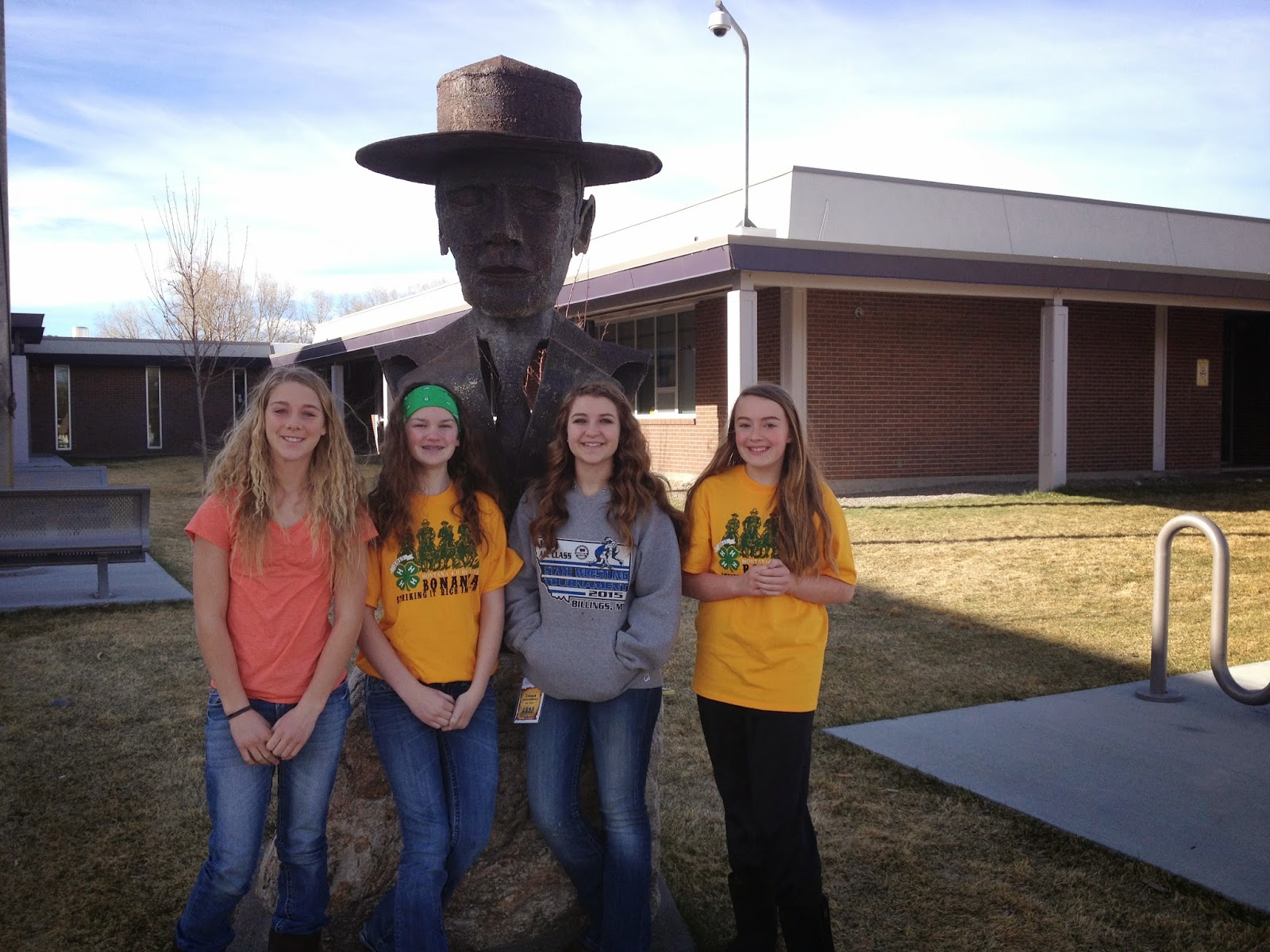
Three Teton County 4-H youth were among the 185 people who recently attended the Montana 4-H Rec Lab in Livingston, Montana, March 27-29.         

Delaynie Beadle, Michaela Gunderson and Brigid Miller attended the training accompanied by Extension Agent, Jane Wolery.  The 4-H members learned a variety of recreational games and mixers that can be used when they lead group events.  The first night they were welcomed by Todd Kesner, Interim Director of the Montana 4-H Center, who spoke on opportunities available in 4-H where members can find their bonanza.  Bonanza, the event theme, is a situation which creates sudden increase in wealth, good fortune or profits – like 4-H! 


4-H members work to build and program a robot cowboy.
4-H members were able to take a variety of classes and the Teton County delegation participated in Cashing in on Your Personality Style, Laser Maze Bonanza, Making Food Fun, Tall Tales Are Pure Gold, Learn to Zentangle, Fill Your Loop Making Rope Baskets, Quick Draw Cooking, Robot Cowboy, Crochet Headband and more. 

Cowboy robot maze.  Did they build and program correctly?
In addition to games, dances and classes, two excellent keynote speakers shared their messages.  Deidre Combs, from MSU, spoke on positive thinking, dreaming, planning and living well.  She shared many lessons from her own life and research as well as some great opportunities for youth.  James Brown, Montana 4-H Alumnus and current Cargill US Dairy Product Line Manager, spoke about how to strike it rich in your life through persistence, networking and goal-setting.    

Building rope baskets.
Gunderson said that one of the key components she took away from the conference was to be more aware of and open to opportunities.  Beadle relayed that she enjoyed the personality workshop and the benefit of recognizing a variety of strengths among people and using those strengths on team projects.  Miller really enjoyed meeting new people from across the state and was excited to learn how to make rope baskets.  Wolery remarked that statewide 4-H events, such as Rec Lab, offer 4-H members a chance to learn a wide variety of skills, practice their leadership and build their confidence.  
Filling Your Loop!


Tuesday, March 31, 2015

From Tongs to Talking Computers

Kitchen tongs/Reacher Tool
One of the things I love about teaching is I get to learn so much.  Sometimes I learn while researching and preparing for a class.  Sometimes I learn because of the individual and collective wisdom of the students in the class.  Last year, while teaching a class on assistive devices, one of the participants was willing to share her ingenious solutions to a diminished range of motion she was experiencing.  The assistive devices class is all about different items that make life easier based on changing abilities.  This great student was also a vibrant educator.  She talked about common household items she was using to make her life easier.  Because of her limited range of reach, she kept a pair of long kitchen tongs tucked between the console and passenger seat of her car. If something dropped in the car, she’d use the tongs to retrieve it.  Which reminds me to mention that for people with limited range, there are attachments that can be placed on seat belts making them easier to reach to pull down.  Many of us wouldn’t think that this seemingly simple task could be much a problem, but I remember my Grandma Bernece couldn’t reach to buckle herself into the car safely following a shoulder injury.  A little, inexpensive device could end up being a life-saver. 

Car handle aid
I also think of the car standing aid and handle, which is a very sturdy-built item that temporarily locks onto door latch.  Grandma Bernece’s bout with polio as a toddler left her with one leg shorter than the other.  She struggled with mobility most of her life, but in her later years, that weak leg made getting into and out of a car more of a challenge.  I wish we had known about the standing aid that would have given her one more place for sturdy grip

Lotion Applier

as she got in and out of the vehicle.  Sometimes the simplest solutions are the best. 

Last week, I was grateful the enthusiast student from the class who also shared that she used a long-handled kitchen spatula to apply lotion to her back.  As I was home alone several days last week, coughing and coughing, I wanted vapor rub applied to my back.  There were just a few spots I couldn’t reach, so I went to the kitchen and got a rubber scraper that had seen it’s better days for kitchen use, and dipped it into my vapor balm and within a few minutes was sleeping peacefully, letting the vapor do its thing.  Hooray for a student who shared a great idea!

Talking Calculator

Most assistive devices, it seems, are born from necessity.  They can be something as simple as an adapted kitchen utensil to as elaborate as a talking computer.  For those who need them, they can bring independence and relief.  Many devices can be tried for free, on loan from MonTech or through contacting LowVision Montana at 1-800-601-5004 or Great Falls Blind and Low Vision Services Team at 1 (888) 279-7527.  Or, you can contact your local MSU Extension Office because it is amazing what we have learned over the years through the classes and students we teach.  

Wednesday, March 25, 2015

The Bendable Straw and more!

Last week, I unexpectedly spent the night in the hospital with a family member who had surgery.  Generally, I keep an extra pair of contacts in my purse or work bag, but on this surprise slumber party, I found I was without both contacts and glasses.  I had just recently mentioned how much I rely on my contacts as an assistive item for my changing vision.  As I prepared for bed, I decided to throw away my daily disposable contacts, thereby giving me a chance to see (or in this case, not see) what is was like to function with my uncorrected vision.  Guess what? When I cannot see, I cannot hear, either!  The poor nurses and doctors who came in, had to stand within a few feet of me, so I could see and hear them.  I bet they were wishing I’d had both my glasses and my mouthwash with me. 

Book with many ideas for adaptations.
While we spent some time in the hospital, I was reminded of one of my favorite assistive products from my youth – the bendable straw.  My Grandma Inez struggled with mobility due to very debilitating arthritis.  When I was a young girl, I’d help out by dispensing her medication.  The bendable straw was so important for Grandma.  It certainly helped keep her from taking an accidental shower every time she needed to swallow a pill. 

There are so many adaptive devices out there, as simple as a bendable straw or as complicated as motion detectors for remote caregivers, monitoring daily activities such as eating and movement.  Many adaptive devices can be fashioned with common items – good old duct tape and baling twine – to make life easier.  I read the book, Double Take, by Kevin Connolly from Helena who was born without legs.  His dad MacGyvered all kinds of adaptive devices for him, including a skateboard, which the author used to get around.  At our office, we have a bookfull of assistive devices that can be made from common objects and used for a wide range of adaptations. 

A few key chapters in the book review switch making and modifications and building spring loaded switches, fasteners and custom grips.  The modifications given have great instructions and colorful pictures.  Some range from simple – adding a self-adhesive rubber bumper to on/off switches on items like electronic toothbrushes for those with dexterity challenges to adaptations for farmers with spinal cord injuries.  The ideas and adaptations that can mostly be created at home are fascinating. 

Sock Puller
I think many of the devices we have today were a result of somebody figuring out how to mass market a good idea.  For instance, a sock puller is a tool that can be used for people with limited flexibility, range or motion.  To use the device, socks are slide onto a cylindrical device and then, using rope handles, the foot is slid into the cylinder and subsequently the sock.  Another device available is a weighted spoon.  For people with tremors in their hands (perhaps from Parkinson’s or other diseases), the weighted spoon can change a person’s ability to feed themselves.  The weight somehow changes messages in the body and brain to reduce tremors.  Imagine if you had lost your ability to feed yourself and suddenly got it back because of something so simple.


To see the many other assistive devices available, stop by the Extension Office.  Just remember to call first, to make sure I have my contacts in, otherwise I might not be able to hear you. 


Wednesday, March 11, 2015

What Devices Help You?

During a state-wide Extension training that our office coordinated and hosted, I commented to the group how much I rely on certain features on my cell phone.  Whenever we took a break, I simply set the timer on my phone and when the alarm sounded, we knew it was time to reconvene.  My phone is only one of many devices I rely on daily to make my life easier.  The same day as our conference, I was scheduled to present a portion of a webinar on “aging in place” and “assistive devices” and it left me thinking about all the devices available to us to make life easier. 

For many of us, the devices help us compensate for a changing ability.  I believe my most important assistive device I use daily are my contacts or glasses.  Sometimes I think about the pioneers who might not have had access to proper eye exams and equipment.  I can only imagine how my uncorrected eye-sight might have directly related to my survival ability.  It is safe to say that any wild game more than three feet away would have been safe from becoming part of my meal!  I’d have had a solely plant-based diet, because at least I could get close enough to see the garden. 
                                                                                                                                                  
In 2012, MonTech and the University ofMontana Rural Institute Center for Excellence in Disability Education, Researchand Service teamed up with MSU Extension to share the message about assistive devices for a variety of abilities and changing capacities.  I thought, over the next few weeks, I’d highlight a few devices that may be of use to you or someone you know.

One of the pretty cool devices is called a PenFriend.  This device is similar in size to a small flashlight.  The pen comes with several stickers.  Following the simple instructions, the pen and stickers can be programmed to “talk” to each other and the user.  For instance, for a person with low-vision, the stickers can be placed on prescription bottles and programmed.  When the user hovers the pen over the sticker, the pen talks.  I programmed one sticker to have information on a type of medication and dosage/time instructions.  It took about 20 seconds.  After seeing the pen demonstrated, a friend bought the pen for her mother who deals with low-vision.  She programmed the stickers around her mother’s house.  Her vision limits her ability to see words on dials and controls of household equipment, but with the pen friend she can “hear” the settings on her dishwasher, washing machine and dryer, and oven range.  Watch a video demonstration.


There are a huge variety of devices available for people with varying levels of vision, but also for a wide variety of needs.  From talking clocks to sock-pullers, there are a variety of devices to assist people with a variety of needs.  For more details, please contact the MSU Extension Office in Teton County.  

Thursday, March 5, 2015

If You Think You'll Live Longer or Shorter, Plan for It!

It is often said that women outlive men.  As a woman, that has always made me kind of happy.  I like my life quite a bit, so to have more of it seems like a good thing.  I think that is too bad for men that they will die sooner.  It wasn’t so long ago that a financial educator pointed out the downside to this fact.  If women live longer, they will need more money.  About the same time that this was pointed out, another professional put it very bluntly, “If you are a married woman, you should plan to be a widow.”  Well, that sure puts a different spin on it, doesn’t it?  Turns out that in addition to liking my life, I also like my husband.  Most days, I like the thought of him being around as we get older.  Just the same, the odds apparently aren’t in favor of that happening. 

As unpleasant as it is to consider our own mortality or that of those we love, it is sure to be part of some future reality.   If you look at the odds and you feel you are likely to outlive those you love, it makes sense to plan for that eventuality.  If you feel the odds are you’ll depart first, it makes sense to plan for your loved ones to be cared for when you are gone.  Do you see where I’m headed?  Either way, planning is important! 

We have an opportunity for you to learn more about planning for your financial future.  Marsha Goetting, MSU Family Economics Specialist, will be in Teton County on Monday, March 9 presenting classes and taking appointments at the Stage Stop Inn.  She’ll present, “Transferring Your Farm or Ranch to the Next Generation” from noon-1:30 p.m. An evening program, “Think You Know Who Receives Your Property When You Pass Away?  Think Again …” will be presented from 6:30-8:30 p.m.  Register for the free classes by contacting MSU Extension in Teton County at 466-2491.  Each session will be different and filled with information useful to families regardless of their ages or financial circumstances.

In addition to the two classes, Goetting will be taking appointments with families or individuals to discuss financial and estate planning.  Each appointment will be 30 minutes in length and filled on a first-registered basis.  Goetting’s primary goal with these sessions is educate people about options to consider and resources available.  No legal advice will be given.  The sessions are also provided free of charge.  There are five sessions still available. 

Some people may feel intimidated by the word “estate” because it sounds rather distinguished and well-to-do. I remember a time when the entirety of my estate would have included exactly two ugly couches. In reality, though, many of us have estate and financial planning considerations, whether we realize it or not.  For instance, do you have a life insurance policy?  If not, is it time to think of one?  How are the beneficiaries designated?  Do you have any bank accounts?  If so, how are they titled?  Do you have minor children?  Who will make decisions on their behalf if something happens to you?  Do you have a conservator or guardian designated in a will?  What about your vehicles or home?  How are they titled?  Do you have long-term care insurance, so that an unforeseen condition doesn’t place undue financial hardship on your family? 


Planning for the financial future may be just as important, if not more so, for those who have less capacity to withstand a hardship as it is for those with large, stately estates.  For people with the resources to do so, charitable giving might be among your considerations.  I often think of the difference the Boe brothers have made to so many individuals and organizations in Teton County with the gifts they planned for with their estate.   I encourage you to register to attend the MSU Extension classes with Goetting, so that you can make sure your resources outlive you and not the other way around.  You may also visit the MSU Extension financial management website, or call your local office, to obtain any of the 75 free resources Goetting has created for Montanans.

Friday, February 27, 2015

Free Estate Planning Classes in the Golden Triangle!

Estate Planning Classes
in the Golden Triangle Area

Marsha A. Goetting, Ph.D., CFP, CFCS
Extension Family Economics Specialist
P.O. Box 172800
Bozeman, MT 59717-2800
phone: (406) 994-5695 fax: (406) 994-4838
E-mail: 
goetting@montana.edu 
Marsha A. Goetting is a Professor and Extension Family Economics Specialist at Montana State University in Bozeman.
She has presented over 800 workshops reaching over 25,000 Montanans with financial and estate planning information. She has also authored over 75 MontGuides and bulletins and has received national, regional, and state awards for her financial management and estate planning programs.


An Extension Directory can be found here.

March 9, 2015 - Teton County 

Transferring Your Farm or Ranch to the Next Generation
·         Stage Stop Inn
1005 Main Ave N
Choteau, MT 59422
·         Noon-1:30 p.m.
·         Free – Register by contacting MSU Extension in Teton County 466-2491 or click here to email to register!

Individual or Family Financial Consultations (30 minutes each)
·         Stage Stop Inn
·         2:00-2:30 p.m., 2:30-3:00 p.m., 3:00-3:30 p.m., 3:30-4:00 p.m., 4:00-4:30 p.m., 4:30-5:00 p.m.

Estate Planning
Think You Know Who Receives Your Property When You Pass Away?  Think Again …
·         Stage Stop Inn
1005 Main Ave N
Choteau, MT 59422
·         6:30 p.m.-8:30 p.m.
·         Free – Register by contacting MSU Extension in Teton County 466-2491

March 10, 2015 – Choteau
Individual or Family Financial Consultations (30 minutes each)
·         Stage Stop Inn
·         8:00-8:30 a.m., 8:30-9:00 a.m., 9:00-9:30 a.m., 9:30-10:00 a.m., 10:00-10:30 a.m.

March 10, 2015 - Toole County

Estate Planning
·         Sunburst Library
Sunburst, MT
·         1:30—3:30 p.m.

·         Comfort Inn of Shelby
455 McKinley
Shelby, MT
·         6:30 p.m.

March 11, 2015 - Liberty County

Estate Planning
Steps everyone can take to simplify estate planning and gift giving
·         Sweetgrass Lodge
511 1st St. W.
Chester, MT 59522
·         6:00 p.m.

March 12, 2015 – Blackfeet 

Estate Planning
Why everyone needs a will..what happens if you don’t have one”
·         Blackfeet Tribal Conference Room
Browning, MT 59417
·         1:00-3:00 p.m.
·         Contact the Blackfeet Extension Office for more information at 338-2650

March 12, 2015 – Glacier County

Estate Planning
·         Glacier County Courthouse Annex
Cut Bank, MT  59427
·         6:30 to 8:30 p.m.
·         Free—Please pre-register for material at 873-2239 or click here to register via email

March 13, 2015 – Blaine County

Estate Planning
·         Montana Seed Show
Harlem High School
Harlem, MT
·         10:00 a.m. - Noon

* Marsha Goetting will also be presenting on Credit Card Smarts to the 6th graders at the Chinook Meadowlark Elementary that afternoon.